Merixa Pest TreatmentMerixa Pest Treatment

Multi-Family Common Area Pest Defense Boston

Multi-family residential buildings across Suffolk County face unique biological pressures due to shared walls, centralized heating infrastructure, and aging building foundations. In historic brick rowhouses across the…
Get My Free Estimate →(339) 463-5669
Multi-Family Common Area Pest Defense in Boston, MA
Quick answer
  • What's included: Comprehensive mechanical inspection of shared entryways, basement masonry void sealing, pipe chase containment, and targeted low-volatility bait placement in utility zones.
  • How fast: Service evaluations are arranged within 24 to 48 business hours, with immediate mechanical exclusion implemented during the initial visit.
  • What it costs: Baseline interventions start at a $150 minimum fee, scaling between $275 and $650 for typical multi-unit buildings based on square footage and baseline entry points.
  • Target pests: Controls Norway rats, house mice, German cockroaches, and subterranean carpet or perimeter beetles across shared transit paths.
  • Scheduling contact: Structural assessments can be scheduled directly by contacting (339) 463-5669 for an on-site property evaluation.

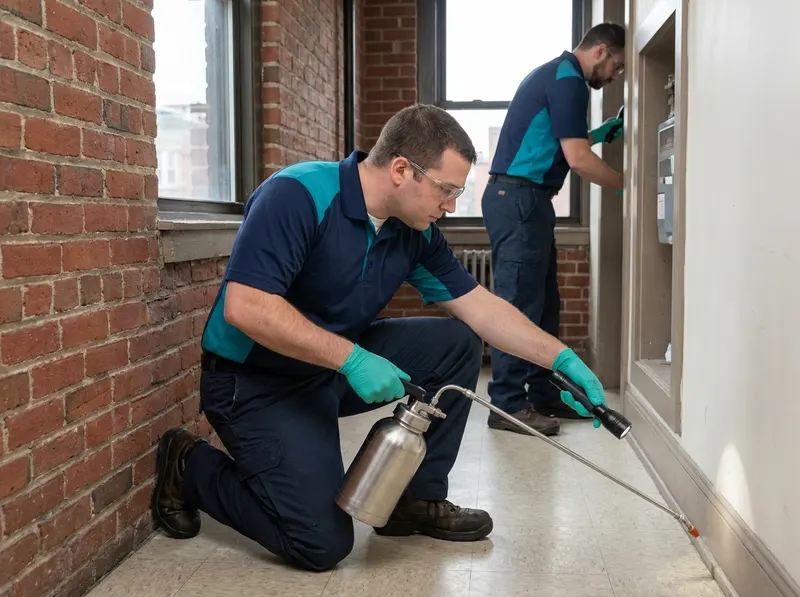
Multi-family residential buildings across Suffolk County face unique biological pressures due to shared walls, centralized heating infrastructure, and aging building foundations. In historic brick rowhouses across the South End, Charlestown, and Beacon Hill, pests do not establish in isolation; they utilize subterranean stone foundations, unused dumbwaiter shafts, and century-old floor joist cavities to travel unseen between residences. Multi-family common area pest defense isolates these pathways. By fortifying common zones such as laundry areas, shared boiler rooms, and main entryway vestibules with copper mesh, elastomeric masonry sealants, and tamper-resistant bait stations, property managers halt the vertical and horizontal dispersal of rodents and insect vectors.

Decision guidance dictates that treating individual tenant units without securing the common infrastructure creates a recurring cycle of re-infestation. If pest activity is detected inside a single apartment, treating only that interior kitchen drives pests deeper into wall cavities and adjoining hallways. Conversely, implementing common area defense cuts off the transit conduit, confining biological pressure to manageable perimeter and basement zones where non-invasive, structural remedies can be systematically deployed. This approach avoids total building evacuations, minimizing disruption for tenants while establishing physical barrier security.

Older construction characteristics throughout Boston present distinct vulnerabilities. Fieldstone basements common in Dorchester, Jamaica Plain, and East Boston often settle, creating gap tolerances exceeding one-quarter inch around gas mains and electrical conduits, sufficient for Norway rats and mice to penetrate. In high-density settings like the North End, Back Bay, and student housing corridors across Allston-Brighton, exterior trash aggregation near rear brick alleyways requires durable exterior-to-interior containment barriers. The operational sequence follows three precise steps: 1. Inspection and mapping of all foundation penetrations, common waste storage corridors, and utility runs. 2. Direct mechanical exclusion using corrosion-resistant metals and structural sealants across entry gaps. 3. Placement of secured, tamper-resistant monitoring and interception devices out of tenant reach.

Multi-Family Common Area Pest Defense cost in Boston

Triple-Decker Common Basement & Hallway Setup$275, $425
Brownstone Shared Basement, Chase & Vestibule Exclusion$350, $550
Mid-Rise (6, 12 Units) Central Utility & Hallway Defense$450, $750
Focused Entry Point Masonry Patching (Minimum Charge)$150

Every job gets a firm, written price after a free on-site visit.

Common questions

How does multi-family common area pest defense in Boston prevent pests from entering tenant units?
The service seals structural apertures exceeding 0.25 inches along shared utility lines, basement sills, and hallway pipe penetrations to physically block pests from transitioning between walls and private living areas.
Do tenants need to vacate Boston properties during common area pest treatments?
No, tenants do not need to vacate because common area protocols utilize mechanical barriers, tamper-evident bait stations, and low-volatility structural treatments that remain confined to shared service spaces without releasing airborne residues.
What is the minimum cost for common area pest defense in Boston?
The absolute minimum charge for common area pest control services is $150, which covers standard site assessment and isolated containment interventions.
How do Boston historic building codes impact common area pest exclusion?
Treatments in historic districts like Beacon Hill and the South End utilize non-destructive, reversible exclusion materials such as breathable copper mesh, brass fittings, and mortar-matched compounds that comply with historic preservation requirements while preventing rodent access.
Is common area defense sufficient if a tenant in Boston already has an active unit infestation?
Common area defense secures the primary migration paths to stop the infestation from expanding throughout the building, though the actively infested unit must also receive localized interior treatment to completely clear the residence.
Helpful resources

Trusted references & local links

USA.gov, government & consumer helpBetter Business BureauFTC Consumer AdviceU.S. Small Business AdministrationReady.govU.S. EPAENERGY STARU.S. Dept. of EnergyConsumer.govU.S. Census BureauGoogle Maps, Boston, MA

Get started today

Tell us about your multi-family common area pest defense job in Boston and we'll send a clear, written quote, usually the same day.

Get your free PEST CONTROL SEVICE quote, Boston

We only use your ZIP to check availability, no spam.