Eastern subterranean termites enter Boston structures through ground-contact points, microscopic mortar fissures in rubble stone foundations, and expansion gaps along concrete basement slabs. In historic neighborhoods…
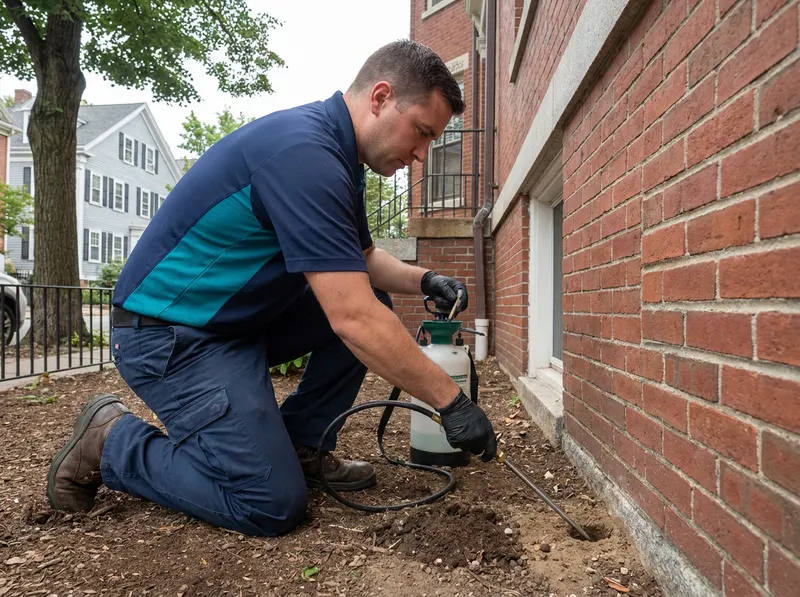
Eastern subterranean termites enter Boston structures through ground-contact points, microscopic mortar fissures in rubble stone foundations, and expansion gaps along concrete basement slabs. In historic neighborhoods such as Beacon Hill, Back Bay, and the South End, high-density brick-and-beam row houses share subterranean soil profiles where moisture migrates continuously from ground level into lower structural joists. Termite workers construct shelter tubes, mud tubes roughly 0.25 inches wide, over non-edible granite footings to reach foundational structural timbers, sill plates, and floor joists. Left unchecked, a mature colony containing 60,000 to 1,000,000 workers hollows out framing along the grain, threatening the architectural integrity of high-value Suffolk County properties.
Perimeter defense stops this migration by decoupling the timber superstructure from the subterranean colony. Traditional repellent sprays merely steer foraging termites toward untreated mortar gaps; decisive control requires an undetectable non-repellent liquid barrier (such as fipronil) or an inground monitoring matrix (using hexaflumuron or noviflumuron chitin synthesis inhibitors). Foraging workers unknowingly carry the non-repellent active agent through the colony via mutual grooming, neutralizing the reproductive queen and collapsing the population within 60 to 90 days. For structures where exterior soil is limited, such as brick sidewalks in the North End or paved alleyways in Charlestown, perimeter defense shifts from soil trenching to low-pressure sub-slab masonry injection, sealing entry points beneath horizontal flatwork without contaminating indoor living airspaces.
Selecting the correct defensive posture depends on foundation architecture. If a property rests on native soil with open yard boundaries, such as detached frames in Jamaica Plain, Dorchester, or Allston-Brighton, a continuous trench-and-rod liquid barrier provides 5 to 10 years of structural exclusion. If a property features zero-lot-line walls or finished walk-out basements common to South Boston and East Boston, an exterior tamper-resistant bait array set at 10-foot intervals offers superior perimeter interception without drilling through decorative stone or historical facade tiles. The trade-off between approaches centers on speed versus physical intervention: liquid barriers deliver immediate lethal clearance at structural entry points, whereas bait stations require quarterly station servicing while preserving exterior ground surfaces.
Every job gets a firm, written price after a free on-site visit.
Tell us about your subterranean termite perimeter defense job in Boston and we'll send a clear, written quote, usually the same day.
 Merixa Pest Treatment